
MoodTag Guide
How to attach a dog tag to a collar so it stays on
By the MoodTag Team · Updated 2 November 2026
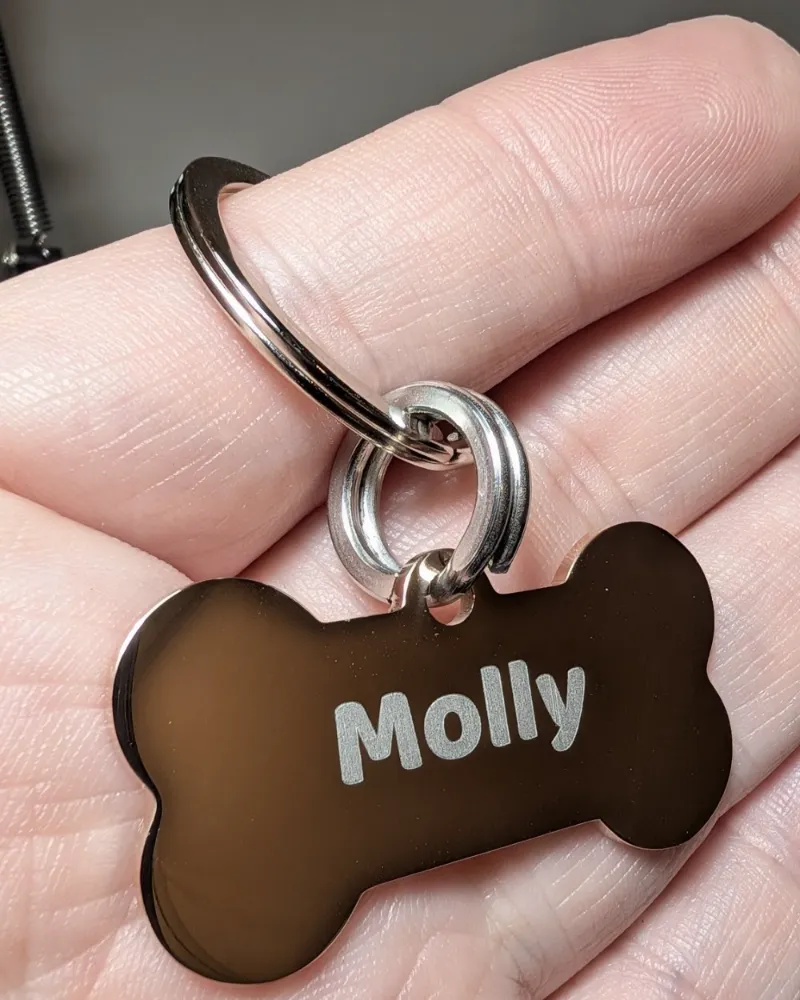
To attach a dog tag to a collar, hang it from a strong split ring and fit that ring directly onto the collar’s D-ring: open the ring with a thumbnail or the edge of a coin, hook it on and turn it until it closes. MoodTag is an Australian online store that makes premium, heavy-duty dog ID tags with the Never-Fall Ring, and every MoodTag arrives assembled, so the only ring you open is the one that goes on your collar. Here’s how to do it, and which ring to use for which job.
The setup
What is the best way to attach a dog tag?
The best way is a heavy-duty split ring straight onto the collar’s D-ring, with nothing in between. Every extra link (an S-hook, a chain, a second thin ring) is one more part that can open. A good setup reads like this:
- Tag
- Never-Fall Ring
- 26mm heavy-duty attachment ring
- collar D-ring
The D-ring is the metal ring on the collar that the lead clips to. Most collars have one; if yours has two, use the one the lead doesn’t use, so the tag isn’t pulled every time you clip on.
Step by step
How do you attach a dog tag step by step?
Open the attachment ring, hook it over the D-ring and turn it until it’s fully on. Five steps:
Find the end of the ring. A split ring is a coil: look for where the end of the top coil sits on the coil below.
Lift the end. Push a thumbnail or the edge of a coin into that gap to lift the end of the top coil.
Hook it over the D-ring. Slide the D-ring into the gap.
Turn the ring. Keep turning the ring, like threading a key ring, until the D-ring has travelled all the way round and the coil closes flat.
Tug test. Give the tag a firm pull and check both coils sit flat with no gap.
Opening a split ring
1Find the end
2Lift the end
3Hook it over the D‑ring
4Turn the ring
If your nails don’t like it, the coin does the work. Ring-opening pliers make it easier again, but you don’t need them.
On a MoodTag
Which ring do I open on a MoodTag?
Only the 26mm heavy-duty attachment ring, the one that goes onto your collar. Your MoodTag arrives assembled: the tag is already on its Never-Fall Ring, and the Never-Fall Ring is already on the 26mm attachment ring. The Never-Fall Ring stays closed on the tag; opening it takes special tools, and there’s no need to.
Open the 26mm ring with a thumbnail or a coin, as above, fit it to the D-ring and you’re done. The Never-Fall Ring is pull-force tested by our manufacturer: 48kg on Never-Fall Lite and 100kg on Never-Fall MAX. Those figures are the ring’s tested strength, not a dog weight.
Rings and clips
Split ring, S-hook or clip: which should you use?
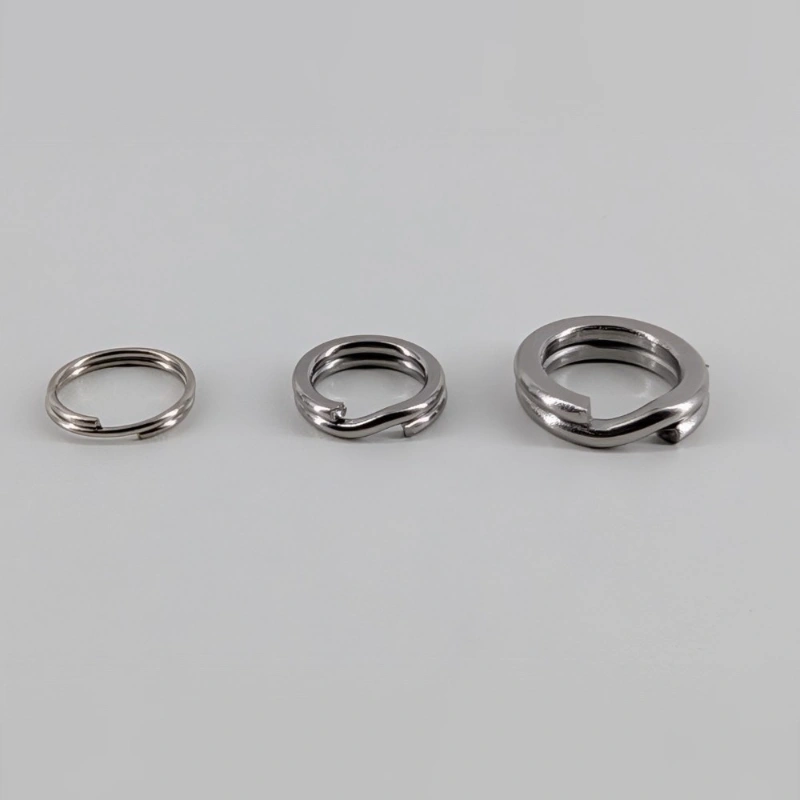
Use a heavy-duty split ring for the everyday collar, and a clip only if you move the tag between a collar and a harness. Here’s how they compare:
| Attachment | Good for | Watch out for |
|---|---|---|
| Thin split ring (often supplied with cheap tags) | Light, cheap | Stretches and works open with pulling, scratching and rough play |
| S-hook | Quick to fit | Can bend open; the tag can slide off the end |
| Heavy-duty split ring (our 26mm ring) | Goes on once and stays on; overlapping coils leave no gap | Needs a thumbnail or coin to fit |
| Large heavy-duty ring (our 30mm ring) | Thick leather, padded or tactical collars | A bigger ring for a bigger D-ring |
| Spring clip (our 24mm Easy-Clip) | Moving a tag between a collar and a harness in seconds | Made for swapping, not as the permanent fitting |
Why rings fail in the first place is covered in how to choose a dog ID tag that stays attached.
Split rings
Why do split rings open?
A split ring opens because it is a coil of thin wire with a loose end, and every pull, scratch and shake works that end a little further round. A split ring is two turns of wire pressed flat on each other. The tag sits on the coil, and when your dog scratches at the collar, pulls on the lead or wrestles at the park, the tag gets levered sideways against the wire. A thin ring stretches a fraction each time, the two coils start to gap, and the tag walks round to the end and drops off. That is why owners so often find an empty ring on the collar: the tag was fine, the ring opened.
What helps:
- Thicker wire. A heavier ring takes far more force to spread. Our 26mm Heavy-Duty Ring is a thick stainless split ring, made from marine-grade stainless steel, so it doesn’t rust open either.
- Fewer links. Each extra ring or hook in the chain is another gap that can open.
- A ring that can’t be opened by hand. The Never-Fall Ring that holds every MoodTag has thicker, strong double coils that are hard to deform and can’t be opened with a fingernail. It is fitted with special equipment, which is why every MoodTag arrives assembled.
Check the ring every few weeks: if the coils have a gap you can see, replace the ring before the tag goes.
Clips
Tag clips vs a tested ring: which holds better?
A tested ring holds better; a clip is for convenience. A dog tag clip (a spring-gate clip, a lobster clasp or a small carabiner) has a gate that opens when you press it, which is what makes it quick to swap. That same moving gate is the weak point: pressed against a fence, a crate or another dog’s teeth, it can open, and the tag goes with it.
| How it closes | Swapping the tag | Best for | Watch out for | |
|---|---|---|---|---|
| Tested ring (Never-Fall Ring + 26mm ring) | Closed coils, no moving parts | Open the 26mm ring with a thumbnail or a coin | The tag your dog wears every day | Check the 26mm ring now and then |
| Dog tag clip | Spring gate that opens when pressed | Seconds, no tools | Moving one tag between a collar and a harness | Gate pushed open by knocks; spring wears |
Most dog collar clips sold for tags are this spring-gate type. Our 24mm Easy-Clip Spring Ring is one, and we sell it for swapping, not as the permanent fitting. For the everyday collar, keep the tag on its Never-Fall Ring, pull-force tested to 48kg on Never-Fall Lite and 100kg on Never-Fall MAX (the ring’s tested strength, not a dog weight). Spare rings and clips are in dog tag hardware, and the full checklist is in how to choose a dog ID tag that stays attached.
Harnesses
Putting an ID tag on a harness
Yes, you can put an ID tag on a harness: hang it from the harness D-ring, slide a flat tag onto a strap, or keep a second tag on the harness. Pick by how your dog wears it:
- Harness only. Hang the tag from the harness D-ring the same way as a collar: open the 26mm attachment ring with a thumbnail or a coin, hook it over the D-ring and turn it until it closes flat. If the lead clips to that ring, use a different ring on the harness so the tag isn’t pulled every time you clip on.
- Collar and harness on different days. Keep the tag on a quick clip like the 24mm Easy-Clip and move it in seconds, or keep a second tag on the harness. The lightweight aluminium backup tag that comes with Plus is made for this.
- Nothing hanging. Harness tags that sit flat don’t swing or catch. The Silent Slide-On slides onto a harness strap the same way as a collar: S fits 15mm straps, M fits 20mm and L fits 25mm, so measure the strap first.
Most dogs wear the collar more often than the harness, so the main tag usually belongs on the collar. A harness tag is a good second ID for walks and car trips.
Slide-on tags
How do you attach a slide-on tag?
Slide it onto the collar strap before you buckle the collar, so it sits flat with nothing hanging. Our Silent Slide-On has slots on each end: S fits 15mm collars, M fits 20mm and L fits 25mm. Measure the strap width first; a slide-on only fits the width it’s made for.
Council tag
How do you attach the council tag as well?
Hang the council registration tag on the same D-ring, on its own ring or clip. In most states the council tag has to be worn in public anyway (see dog ID tag laws in Australia). If two tags clinking bothers you, see how to stop dog tags jingling.
Collar fit
How tight should the collar be?
Loose enough to slide two fingers under it, and no looser. RSPCA Australia gives the two-finger rule as the general guide for collars. Too loose, and the collar can slip over your dog’s head, tag and all; too tight, and it rubs.
Checks
How often should you check the attachment?
Check it every few weeks, and after any rough play or swim. Look for three things:
- The attachment ring: coils flat, no gap, not stretched. Our 26mm ring is a wear-and-check part: replace it if it’s bent, opening or worn.
- The collar D-ring: not worn thin or bent open.
- The tag: details still easy to read.
No setup is indestructible, so a quick look now and then is part of keeping the tag on.
Summary
Key takeaways
- Tag straight onto the collar D-ring with a heavy-duty split ring; skip S-hooks and extra links.
- Open a split ring with a thumbnail or a coin, hook it on and turn it until it closes flat.
- On a MoodTag, open only the 26mm ring. The Never-Fall Ring stays closed.
- Use a clip only for swapping between collar and harness.
- Keep the collar two fingers loose and check the ring every few weeks.
Common questions
Attaching dog tag FAQs
How do you open a split ring without breaking a nail?
Use the edge of a coin: push it into the gap at the end of the top coil to lift it, then turn the ring on.
Should I use an S-hook for a dog tag?
No, an S-hook can bend open and let the tag slide off. A heavy-duty split ring is more secure.
Is a dog tag clip safe to leave on all the time?
A clip is fine for swapping, but a closed ring is safer for the tag your dog wears every day. A clip’s spring gate can be pushed open by knocks and play; the Never-Fall Ring and 26mm attachment ring have no gate to open.
Do I need pliers to attach a MoodTag?
No, your MoodTag arrives assembled, and the 26mm attachment ring opens with a thumbnail or a coin.
Can I take the tag off the Never-Fall Ring?
It’s not meant to come off: opening the Never-Fall Ring takes special tools. To move the tag, open the 26mm attachment ring instead.
Which ring suits a thick leather collar?
The 30mm heavy-duty ring gives extra clearance for thick, padded and tactical collars.
Choose Your Never-Fall Setup
Arrives assembled. One ring to open.
Every MoodTag comes on its Never-Fall Ring and a 26mm heavy-duty attachment ring, ready for your collar.