
MoodTag Materials Guide
Best material for dog tags: stainless steel, brass, aluminium and more
By the MoodTag Team · Updated 2 November 2026
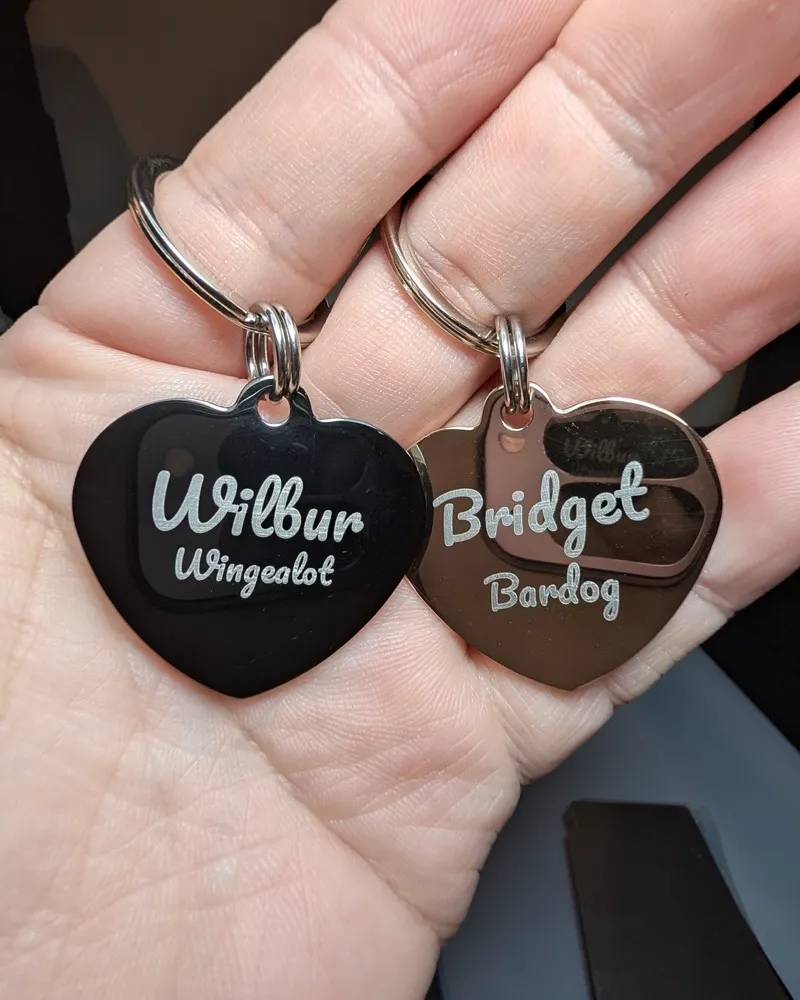
Stainless steel is the best material for dog tags for most Australian dogs. It doesn’t rust in normal wear, keeps deep engraving readable for years and handles salt water, mud and rough play better than brass, aluminium or silicone. MoodTag is an Australian online store that makes premium, heavy-duty dog ID tags with the Never-Fall Ring, and every MoodTag is a stainless steel tag with deep laser engraving, fitted to a pull-force tested Never-Fall Ring. This guide compares each material honestly, including the one we use for our spare tags, and explains why the ring deserves the same attention as the metal.
Material comparison
What is the best material for a dog tag?
Stainless steel, unless your dog needs a silent tag or the lightest tag possible. Most metal dog tags are stainless steel, brass, aluminium or titanium, and the non-metal options are plastic, resin and silicone. Each dog tag metal trades weight, wear and looks differently:
| Material | Weight | Rust and tarnish | How the engraving or print holds up | Typical use |
|---|---|---|---|---|
| Stainless steel | Heavier than aluminium or titanium | Doesn’t rust in normal wear; can tea-stain near the surf (cosmetic) | Holds deep engraving well | Most dogs, swimmers, active dogs |
| Brass | Heavier than aluminium | Darkens (tarnishes) over time | Engraves well; contrast can dull as it darkens | A classic look, if you don’t mind polishing |
| Aluminium | About one third the weight of steel of the same size | Doesn’t rust; coloured surface can scratch | Soft metal, so it marks and wears faster | Very small dogs, spare or backup tags |
| Titanium | Light | Resists corrosion, including sea water | Engraves well | Light and strong, at a higher price |
| Gold-colour finish over steel | Same as the steel underneath | The steel doesn’t rust; the colour can wear a little on the edges | Engraving cuts through the colour and reads bright | A gold look with steel strength |
| Solid gold | Very heavy | Doesn’t tarnish | Quite soft, so it scratches and dents | Jewellery, rarely a working dog tag |
| Plastic or resin | Very light | Doesn’t rust | Printed designs sit on the surface and can rub off; chewing marks it | Colourful picture tags |
| Silicone | Very light | Doesn’t rust | Soft, so details are easier to damage | Quiet tags for dogs that don’t chew them |
Noise: every hanging metal tag can clink against other hardware; silicone and slide-on tags are the quiet options.
A quick way to choose: if your dog swims, plays rough or has lost a tag before, go stainless. If noise is the only problem, a slide-on stainless tag fixes it without giving up durability (more on that below).
Choosing more than the material? Our buying guide to the best dog tags in Australia covers the ring, engraving, size and noise.
Stainless vs aluminium
Stainless steel vs aluminium dog tags: which lasts longer?
Stainless steel lasts longer. Aluminium is about one-third the weight of steel, which makes it light and cheap, but pure aluminium is also a soft metal, so the tag scratches, dents and wears down faster on an active dog.
Most coloured aluminium tags are anodised: the surface is turned into a thicker oxide layer that takes colour. That layer has low to moderate wear resistance, which is why bright aluminium tags often fade or scuff at the edges first.
Stainless steel is a group of steels with at least 10.5% chromium. The chromium forms a thin oxide film on the surface that protects the steel and repairs itself in air when it’s scratched. That is why a stainless tag keeps its shape and its engraving through the knocks an aluminium tag can’t take.
Where aluminium makes sense: we use it ourselves for the lightweight backup ID tag that comes with Plus. A spare tag in a drawer or on a harness doesn’t face the daily wear of the main tag, so light weight matters more than toughness there. Your dog’s everyday tag is stainless steel.
Brass
Is brass or stainless steel better for a dog tag?
Stainless steel is better for most dogs, because brass tarnishes and stainless steel doesn’t. Brass is an alloy of copper plus zinc, and polished brass darkens over time from sulfur-containing gases in the air.
In the brass vs stainless steel dog tags comparison, looks are where brass wins: some owners love that aged, darker tone. The catch is readability: as brass darkens, the contrast between the engraving and the tag can drop, and keeping it bright means regular polishing. Stainless steel keeps its finish without that upkeep, so the phone number stays as easy to read as the day it arrived.
Gold
Are gold dog tags durable?
A gold-colour tag over stainless steel is as durable as the steel underneath; a solid gold tag is not, because gold is soft. "Gold dog tags" can mean three different things, so check which one you are buying:
- Solid gold. Geoscience Australia describes gold as quite soft, and pure gold is rarely used for that reason, so it is alloyed with other metals. On a dog that digs, swims and plays, a soft tag scratches and dents, and it is costly to lose.
- Brass. Brass looks gold when it is new, then darkens over time (see brass vs stainless steel above).
- A gold-colour finish over stainless steel. This is what MoodTag Gold and Rose Gold are: the same 2.0mm stainless steel tag with a coloured finish on top. The laser cuts through the colour into the steel, so the engraving reads bright, never black. The colour can wear a little on the edges over time with rough play; the steel and the engraving underneath stay.
If you want the gold look on a tag that goes everywhere your dog goes, a gold finish over steel gives you that without the softness of real gold.
Silent options
Are silicone dog tags better than metal?
Only if silence is the main goal. Silicone tags are silent and very light, but they are soft, so a dog that chews or scratches at its collar can damage them.
If your dog’s tag noise is the problem, you don’t need to give up metal. The Silent Slide-On is a mirror-polished stainless steel tag with deep laser engraving that slides onto the collar or harness with no hanging hardware, so there is no jingling at all. It comes in three sizes to fit 15mm, 20mm and 25mm collar webbing.
Titanium
What about titanium dog tags?
Titanium is a good material, just an expensive one. It has low density and high strength and resists corrosion in sea water, so a titanium tag is light and tough. For most dogs, a stainless steel tag gives the same practical result at a lower price: it doesn’t rust in normal wear and holds deep engraving. We don’t sell titanium tags.
Rust
Do dog tags rust?
Stainless steel dog tags don’t rust in normal wear; tags made of plain (non-stainless) steel can. Near the beach, stainless steel can pick up a light brown surface mark called tea staining. The Australian Stainless Steel Development Association says tea staining is most common within about five kilometres of the surf and is a cosmetic issue that doesn’t affect the strength or life of the steel.
If your dog swims at the beach, give the tag a rinse in fresh water afterwards, the same way you’d rinse the collar. ASSDA’s advice for stainless steel is mild soap or detergent with warm water, then a clean rinse. Avoid bleach and harsh abrasive cleaners, which damage the surface. More in our guide to dog tags for dogs that swim.
Tarnish
What kind of dog tag won’t tarnish?
A stainless steel tag won’t tarnish. Brass and copper tags darken over time as the metal reacts with the air. Plain stainless steel keeps its finish because its protective film renews itself, so there is nothing to polish back.
Finishes
Dog tag finishes: does the colour change anything?
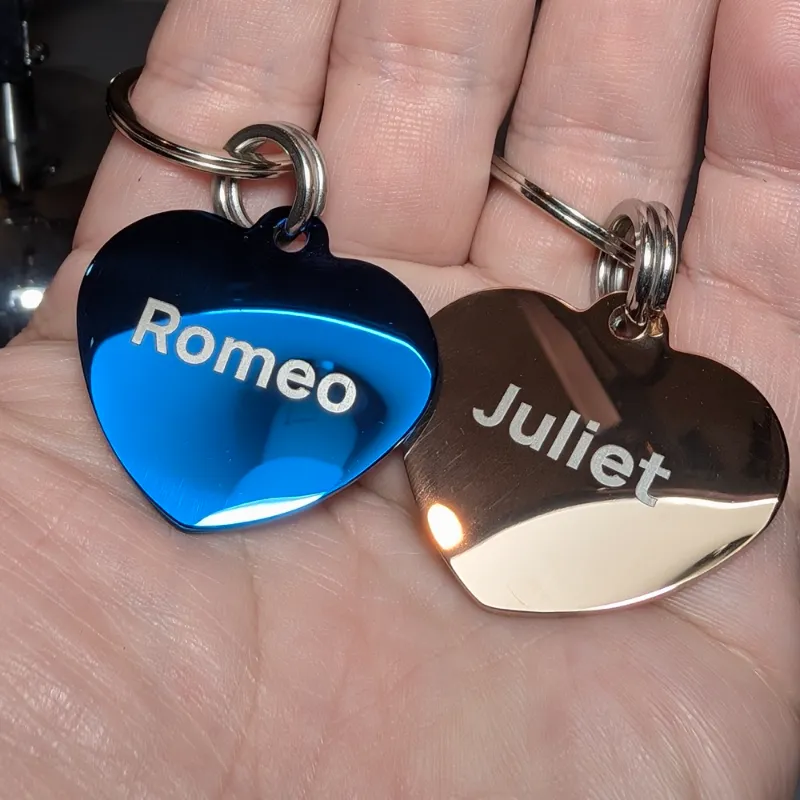
The colour changes the look, not the strength or the engraving. MoodTag tags come in Stainless, Black, Gold, Rose Gold and Navy. Every one is the same stainless steel tag; the coloured options have a coloured finish on top of the steel.
What to expect from a coloured finish:
- Engraving shows bright. Deep laser engraving cuts through the colour into the steel, so the details read as light text on the coloured tag. MoodTag engraving is never black.
- Edges can wear a little. On a dog that plays rough, the colour can wear slightly on the edges over time. The steel and the engraving underneath stay.
- Plain Stainless has nothing to wear. If your dog is hard on its gear and you want the tag to look the same in a few years, choose Stainless.
The finish doesn’t change the ring either: the Lite or MAX choice sets the Never-Fall Ring strength, whatever colour you pick.
Engraving
Engraving depth matters as much as the metal
A tough material is wasted if the engraving is shallow. Surface-printed or lightly marked tags can fade as the tag rubs against the collar, the bowl and the ground, even on good steel.
MoodTag uses fibre laser engraving that removes material to roughly 0.05mm to 0.10mm deep, depending on the tag and the engraving area. You can feel the letters with your fingertip, yet the grooves are shallow enough to wipe clean. Every engraved tag is covered by our Lifetime Engraving Readability Promise: if normal wear makes the details unreadable, we replace the tag. See how deep laser engraving works.
The ring
The material nobody checks: the ring
The ring is where most dog tags are lost. A good stainless steel tag rarely breaks; what fails is the thin split ring holding it on, which stretches, twists and works open during pulling, scratching and rough play. Owners tell us the same story: the tag was fine, the ring was empty.
That is why every MoodTag hangs on a Never-Fall Ring, pull-force tested on a testing machine by our manufacturer before it is shipped to us:
| Setup | Never-Fall Ring pull-force tested to | Best for |
|---|---|---|
| Never-Fall Lite | 48kg | Everyday active dogs, playful dogs, daily walks, dog parks, active small dogs |
| Never-Fall MAX | 100kg | Strong pullers, rough play, escape artists, large dogs, rescues |
The 48kg and 100kg figures are the ring’s tested pull-force, not your dog’s body weight. The setup arrives assembled: tag, Never-Fall Ring and a 26mm Heavy-Duty Attachment Ring that clips to the collar D-ring.
- Tag
- Never-Fall Ring
- 26mm Heavy-Duty Attachment Ring
- Collar D-Ring
For the full checklist, read how to choose a dog ID tag that stays attached.
Why stainless
Why MoodTag uses stainless steel
We use stainless steel because a dog tag has one job: someone who finds your dog has to be able to read your number. Stainless steel gives us three things for that job:
- It stays readable. It holds deep laser engraving and doesn’t tarnish, so the contrast stays.
- It handles Australian conditions. Salt water, sand, mud and heat are part of normal life for a lot of Australian dogs.
- It lasts with the ring. A tag that outlives a weak split ring is only half a solution, so we pair it with the Never-Fall Ring and back both with written guarantees: the 90-Day Money-Back Guarantee, the Lifetime Engraving Readability Promise and the Lifetime Never-Fall Ring Guarantee. See MoodTag guarantees.
What to look for in stainless steel dog tags: the best stainless steel dog tags combine deep engraving (not surface printing), a smooth, polished finish (the kind the Australian Stainless Steel Development Association recommends near the coast), and tested hardware rather than a thin split ring.
Is stainless steel too heavy for a small dog? Not with the right shape. Our lightest tags weigh 6g (Classic Star) and 8g (Signature Bone and Luna Heart), and every product page lists the exact weight and size. The dog tag size guide matches shapes to dog sizes.
Shop our stainless steel dog tags.
Care
How do you care for a stainless steel dog tag?
Rinse it, wipe it and check the rings. A stainless tag needs very little care:
After the beach or a swim: rinse the tag and collar in fresh water.
Now and then: wash with mild soap and warm water, rinse, and dry. A polishing cloth brings back the shine.
Every month or so: check the 26mm attachment ring for wear, bending or opening. It’s a replaceable wear-and-check part.
Skip: bleach and harsh abrasive cleaners.
For a swimmer’s full routine, see our guide to dog tags for dogs that swim.
Summary
Key takeaways
- Stainless steel is the best all-round dog tag material: no rust in normal wear, no tarnish, holds deep engraving.
- Brass tarnishes, aluminium is light but soft, titanium is light and costly, silicone is silent but soft.
- Want no noise? A slide-on stainless tag is silent and still engraved.
- Coloured finishes change the look, not the strength; plain Stainless shows the least wear.
- The ring matters as much as the metal: choose a tested ring, not a thin split ring.
Common questions
Dog tag materials FAQs
What kind of metal are dog tags made of?
Most dog tags are stainless steel or aluminium, with brass and titanium as less common options and silicone as the non-metal choice. Every MoodTag is stainless steel; only the lightweight Plus backup tag is aluminium.
Are brass dog tags good?
Brass dog tags are good for looks but need upkeep. Brass is copper and zinc, and it darkens over time, so the contrast between the engraving and the tag can drop unless you polish it. If you want a tag that stays easy to read without polishing, choose stainless steel.
Are gold dog tags durable?
A gold-colour finish over stainless steel is durable; solid gold is soft and scratches easily. MoodTag Gold and Rose Gold tags are 2.0mm stainless steel with a coloured finish, deep laser engraved, so the steel and the engraving stay even if the colour wears a little on the edges.
Are aluminium dog tags good?
Aluminium dog tags are good when light weight matters most, but they wear faster than stainless steel. Aluminium can weigh about a third of the same piece of steel, and it is a softer metal, so the tag and its engraving mark more easily. We use aluminium only for the lightweight Plus backup tag; every main MoodTag is stainless steel.
Can you put a dog tag on a harness?
Yes. The Silent Slide-On slides onto a collar or harness strap, and a Never-Fall setup clips onto any D-ring with its 26mm Heavy-Duty Attachment Ring.
Does the finish change the strength of the tag?
No. The finish changes the look of the tag. The Lite or MAX choice sets the Never-Fall Ring strength: 48kg-tested for Lite and 100kg-tested for MAX.
Will a gold or rose gold dog tag fade?
The colour can wear a little on the edges over time on a dog that plays rough, but the steel and the engraving underneath stay readable. If you want no visible wear at all, choose plain Stainless.
Can a stainless steel dog tag go in salt water?
Yes. Stainless steel handles swimming and beach days; rinse it in fresh water afterwards to keep it bright and avoid tea staining, the light brown surface mark salt air can leave on steel near the coast.
Do 48kg and 100kg refer to my dog’s body weight?
No. The 48kg and 100kg ratings refer to pull-force testing on the Never-Fall Ring. They do not refer to your dog’s body weight.
Is a silicone tag better for a dog that hates the jingle?
A silicone tag is quiet, but a stainless slide-on tag is quiet too and keeps deep metal engraving. The Silent Slide-On sits flush on the collar, so there is no jingling.
What is the Plus backup tag made of?
Aluminium. It’s a lightweight spare ID tag for a harness, a second collar or a drawer, so weight matters more than toughness. Your dog’s main MoodTag is stainless steel.
Choose Your Never-Fall Setup
A tag that stays readable, on a ring that stays on
Choose Lite for strong everyday durability or MAX for strong pullers, rough-play dogs, escape-prone dogs and dogs that have lost tags before. Want silent? Choose the Silent Slide-On.