
MoodTag Guide
Waterproof dog tags: the right ID tag for a dog that swims
By the MoodTag Team · Updated 22 November 2026
For a dog that swims a lot, the right ID tag is marine-grade stainless steel with the details deep laser engraved into the metal, held on by a ring that can’t twist open, or a flat slide-on tag that sits on the collar. MoodTag is an Australian brand specialising in premium Never-Fall dog ID tags for active dogs, and plenty of our customers’ dogs wear them in the surf, the creek and the pool. This guide explains what water actually does to a tag, and how to choose and look after one for a swimmer.
Choosing a tag
What dog tag is best for a dog that swims a lot?
A stainless steel tag with deep engraving, on a strong ring or flat on the collar. Water rarely destroys a tag outright. It wears out the weak parts one swim at a time: printed lettering rubs off, colour coatings chip, and thin split rings open while your dog paddles, shakes and plays.
What water does to each part of a tag
| Part | What salt water, pools and sand do | What to look for |
|---|---|---|
| The tag | Soft metals scratch and dent; some tarnish or lose their colour | Marine-grade stainless steel |
| The lettering | Printed or shallow lettering wears smooth | Deep laser engraving cut into the metal |
| The colour | Coatings and dyed layers can wear at the edges | Plain stainless shows the least wear |
| The ring | Thin split rings stretch and twist open in wet play | A ring that can’t be opened with a fingernail, or no ring at all (slide-on) |
| The collar | Salt and sand sit in the webbing and the D-ring | Rinse and dry it after swims |
Pick by what your dog does in the water, not by size. A calm paddler needs a readable tag that stays put. A dog that charges into the surf, wrestles in the shallows or brings back sticks needs the strongest ring you can get. Those are the dog tags for swimming dogs we suggest, and the best dog tags for swimming dogs are simply the ones whose weakest part still holds after a summer at the beach.
Waterproof
Are dog tags waterproof?
Metal dog tags are waterproof; the question is how well the lettering, colour and ring hold up after hundreds of swims. A stainless steel tag won’t dissolve or go soggy. What fails is everything around the steel: lettering printed on top, a colour layer, or the ring that holds it on. That’s why "waterproof" on its own tells you very little. When you compare waterproof dog ID tags, ask what the tag is made of, how the details are put on, and what holds it to the collar.
Materials
Which tag material handles salt water and pools?
Stainless steel handles salt water and pools best for everyday wear. Here’s how the common materials compare for a dog that swims:
- Stainless steel: doesn’t rust in normal wear, holds deep engraving and stays smooth. It can pick up a light surface mark near the sea (see tea staining below).
- Aluminium: light and cheap, but soft, so it scratches and dents. Coloured aluminium tags are usually anodised, a dyed oxide layer typically 5 to 30 thousandths of a millimetre thick that is brittle under knocks, so the colour can wear off on rocks and sand.
- Brass: sturdy, but it tarnishes and darkens over time.
- Silicone: quiet and soft, but softer than metal, so it’s easier to chew, tear or scratch.
- Enamel or colour-filled tags: the colour sits on top of the metal or in a recess, so it can chip on rocks; the metal underneath decides how long the tag lasts.
For a full material comparison, see our guide to the best material for dog tags.
Salt water
Will salt water rust a stainless steel dog tag?
No, a stainless steel dog tag won’t rust from salt water in normal wear, but near the sea it can pick up a light brown mark called tea staining. The Australian Stainless Steel Development Association (ASSDA) says tea staining is a cosmetic issue that doesn’t affect the strength or lifetime of the steel, and that it’s most common within about five kilometres of the surf.
Two things in ASSDA’s explanation matter for a dog tag:
- Sea salt stays wet for a long time on stainless steel, which keeps the surface corroding longer than plain table salt would.
- Grooves and rough surfaces trap salt. Surfaces smoother than about 0.5 µm are much less susceptible, which is one reason a polished tag holds up better than a rough one.
An engraved letter is a small groove. So after a swim in the sea, rinse the tag in fresh water to wash the salt out of the engraving, the same way you’d rinse the collar. If a light brown mark does appear, a wash with mild soap and warm water, then a polishing cloth, usually brings the shine back.
Pools
Is chlorine in a pool bad for a dog tag?
Pool water won’t harm a stainless steel tag if you rinse it afterwards. Stainless steel is used almost everywhere around pools, for railings into the water and fittings, because it resists staining and corrosion from pool chemicals. Coloured coatings, soft metals and the collar itself are more likely to fade or wear with regular pool time, so a fresh-water rinse after the pool is a good habit for all of them.
Engraving
Will the engraving survive swimming?
Yes, if the details are engraved into the metal rather than printed on top. MoodTag tags are deep laser engraved: a fibre laser cuts the details about 0.05 to 0.10mm into the steel, so the letters are recessed and you can feel them. Water, sand and salt can’t wash off lettering that is part of the tag.
Printed tags and shallow surface marking are a different story. Sand works like fine sandpaper on a wet tag, and printed details wear smooth. If normal wear ever makes your MoodTag engraving unreadable, our Lifetime Engraving Readability promise replaces the tag.
A QR code tag has the same weakness as print: it only works while a phone camera can read the whole pattern, so scratches and fading matter more than on engraved letters. If you use one, keep an engraved phone number on the tag as well.
Hanging or slide-on
Hanging tag or slide-on for a dog that swims?
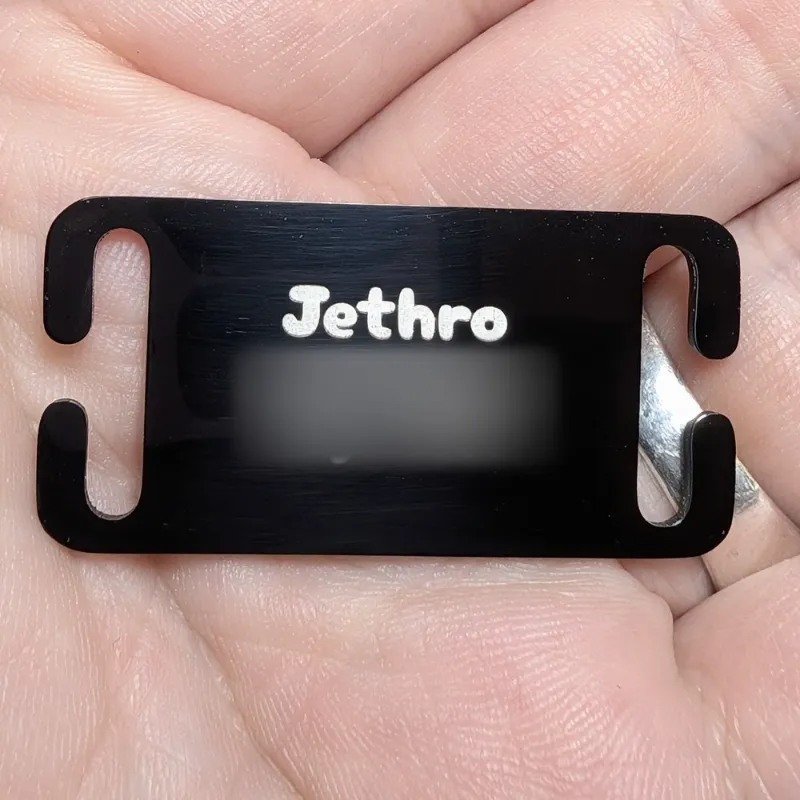
Choose a slide-on if your dog swims around rocks, reeds or snags, and a hanging tag if you want details on both sides or swap collars. Both work in water; the difference is what moves.
- Hanging Never-Fall tag: engraved front and back, and it moves to a new collar in a minute. It swings in the water, so the ring does the hard work. Our Never-Fall Ring is pull-force tested to 48kg (Lite) or 100kg (MAX). Those are the tested strengths of the ring itself, not a dog weight limit.
- Silent Slide-On: a mirror-polished stainless steel plate the collar threads through, engraved on one side. Nothing hangs, swings or catches, and there’s no ring to open. S fits 15mm collars, M 20mm and L 25mm. The trade-off: it stays with that collar, and a buckle or council tag can still make a sound.
Not sure which ring strength? Go by behaviour, not weight. Lite suits most swimmers; choose Never-Fall MAX if your dog plays rough in the water, pulls hard or has lost a tag before.
The ring
Why does the ring matter more for a swimming dog?
Because most tags are lost when the ring opens, not when the tag breaks, and wet play gives a ring more work. Waves, shaking off, rolling in the sand and other dogs grabbing at the collar all twist a thin split ring until it works open, and a tag lost in the water is hard to find.
A MoodTag replaces that weak link with the Never-Fall Ring: thick double coils that can’t be opened with a fingernail, fitted with special equipment, so every setup arrives assembled. The 26mm attachment ring that goes on your collar is a wear-and-check part. On a dog that swims often, look at it every few weeks for wear, bending or opening. More in dog tags that won’t fall off.
Colours
Do coloured dog tags hold up in water?
Coloured tags work for swimmers, but plain Stainless shows the least wear. Every MoodTag is the same stainless steel tag; Black, Gold, Rose Gold and Navy have a coloured finish on top of the steel. Engraving cuts through the colour, so the details read bright. On a dog that plays hard in the sand and surf, the colour can wear a little at the edges over time. The steel and the engraving underneath stay. If you want the tag to look the same in a few years, choose Stainless.
Care
How do you look after a dog tag after a swim?
Rinse it, dry the collar and check the rings. A swimmer’s tag needs a minute of care:
After the beach or the pool: rinse the tag, rings and collar in fresh water to wash out salt, chlorine and sand.
Let the collar dry before it goes back in a drawer or on a hook, so salt and sand don’t sit in the webbing.
Every few weeks: check the 26mm attachment ring and the collar’s D-ring for wear, and make sure the engraving still reads clearly.
Now and then: wash the tag with mild soap and warm water, rinse and dry. A polishing cloth brings back the shine.
Skip: bleach and harsh abrasive cleaners. ASSDA lists bleach among the things that stain stainless steel.
After the swim
Rinsethe tag and collar
Drylet the collar dry
Checkthe rings
Engraving layout
What should a swimming dog’s tag say?
Your dog’s name and a mobile number you’ll answer, kept short so the letters stay large. A wet, excited dog on a beach is held by a stranger for a minute at most, so the phone number is the line that matters. Put the name and a short line on the front and your number on the back; see what to put on a dog tag for examples. Your council registration tag stays on alongside, and the rules for your state are in our dog ID tag laws guide.
A customer’s dog
A real swimmer: Ted
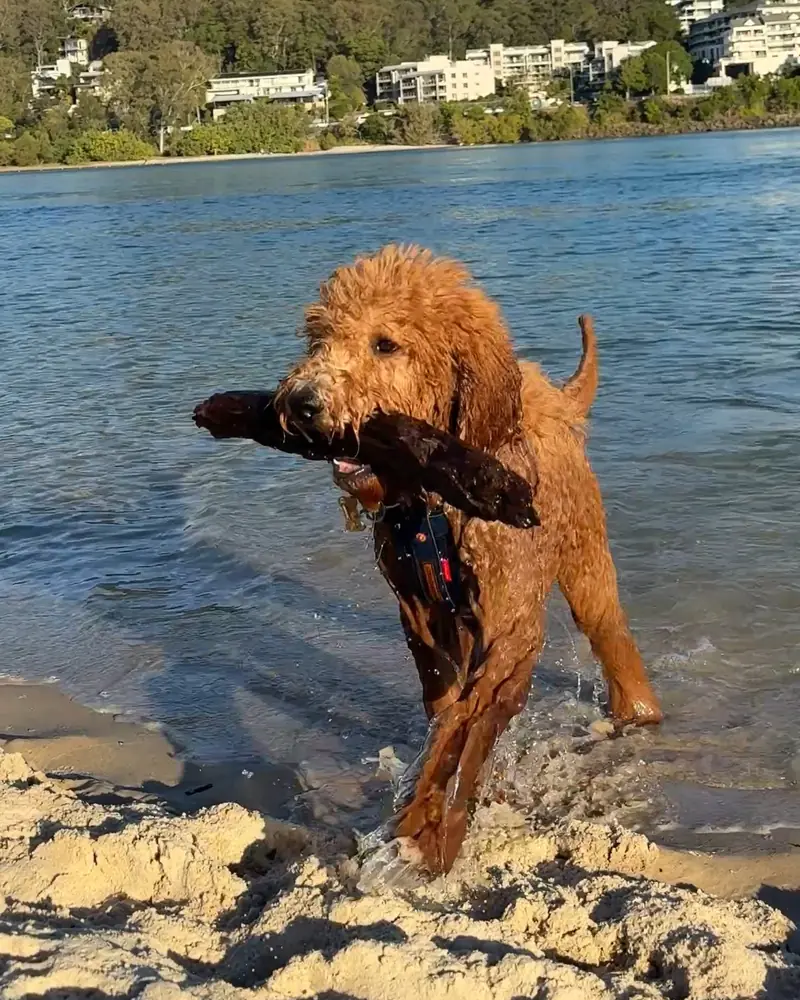
Ted is one of our customers’ dogs, and he spends a lot of time in the water. Here he is on the Gold Coast, swimming out after a stick and running back up the sand with his MoodTag on. It’s the kind of day a swimmer’s tag has to survive: salt water, sand, a stick and a lot of shaking off.
Summary
Key takeaways
- Metal tags are waterproof; the lettering, colour and ring are what wear out.
- For a dog that swims a lot: marine-grade stainless steel, deep laser engraving, and a ring that can’t twist open or a flat slide-on.
- Near the sea, stainless steel can tea stain. It’s cosmetic; a fresh-water rinse after swims keeps salt out of the engraving.
- Rinse after the pool too, and let the collar dry.
- Check the rings every few weeks on a regular swimmer.
Common questions
Swimming dog tag FAQs
Can my dog swim with an ID tag on?
Yes, a stainless steel tag with engraved details can go in the sea, rivers and pools. Rinse the tag and collar in fresh water afterwards, and check the ring now and then.
Can my dog have a bath with the tag on?
Yes, bath water won’t hurt a stainless steel tag. You may still prefer to take the collar off, so you can wash and dry the neck properly.
What kind of dog tag won’t tarnish?
A stainless steel tag won’t tarnish. Brass and copper darken over time, and coloured coatings can wear; plain stainless keeps its finish.
Are aluminium dog tags OK for swimming?
They’re fine in the water but wear faster. Aluminium is soft, and the colour on most aluminium tags is a thin dyed layer that can wear off on rocks and sand.
Do silicone tags work for swimming dogs?
They work, and they’re quiet, but silicone is softer than metal, so it’s easier to chew, tear or scratch.
Will my dog’s tag go brown at the beach?
It can pick up a light brown mark called tea staining if you live near the surf. It’s cosmetic, and mild soap, warm water and a polishing cloth usually remove it.
Should my dog wear a slide-on or a hanging tag for swimming?
A slide-on suits dogs that swim around rocks, reeds and snags, because nothing hangs. A hanging Never-Fall tag suits dogs that swap collars or need details on both sides.
Should I take my dog’s collar off for swimming?
Leave it on for a supervised swim, so your dog can be identified if it runs off. If the collar could catch on something during rough play or in thick reeds, take it off for that session.
A tag that keeps up with your swimmer
Choose a Never-Fall Lite or MAX tag in marine-grade stainless steel, assembled before it ships, or the Silent Slide-On for nothing hanging at all. Free shipping Australia-wide.