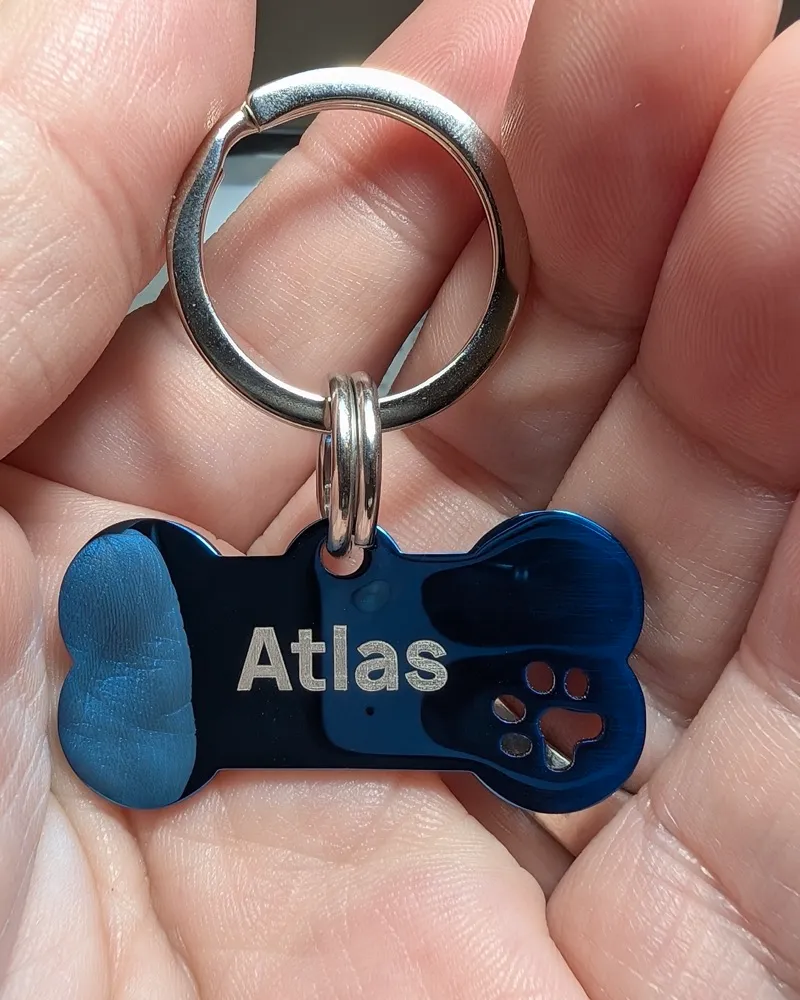
How To Choose A Dog ID Tag That Won’t Fall Off
If your dog keeps losing tags, the problem is usually not just the tag. It is the full ID setup: the tag body, the ring, the attachment point, the way it hangs, and how your dog actually moves.
What Is A Stay-On Dog ID Tag Setup?
A stay-on dog ID tag setup is not just a stronger tag. It is a complete identification system designed to reduce the common failure points that cause ordinary dog tags to fall off, bend, snap, open, catch, swing, or disappear during everyday movement.
MoodTag’s method is simple: choose the ID setup based on your dog’s behaviour, not just the shape or colour of the tag.
The MoodTag Stay-On Formula
- Readable tag: Deep laser engraved details
- Strong hardware: Better attachment points
- Right setup: Matched to your dog’s activity level
- Lower failure risk: Less reliance on weak small rings alone
- Backup thinking: Extra ID for maximum peace of mind
Most Dog Tags Do Not Fall Off Because Of The Tag Alone
When a dog loses their ID tag, owners often blame the tag. But in real life, the weak point is often the setup around the tag.
The small split ring opens
Thin standard rings can bend, stretch, open, or pull apart when a dog runs, wrestles, rolls, catches the tag, or plays rough.
The tag swings and catches
A dangling tag moves independently from the collar. That movement can create extra stress when the tag catches on grass, fences, crates, decking gaps, or another dog’s mouth during play.
The hardware is chosen for looks, not behaviour
A tag that works for a calm indoor dog may not suit a dog that pulls, swims, hikes, rolls, wrestles, or plays hard at the park.
The setup is never checked
Any collar hardware can wear over time. A stay-on setup still needs regular checking, especially for active dogs.
The MoodTag 5-Point Stay-On Test
Before choosing a dog ID tag, use the MoodTag 5-Point Stay-On Test. This method helps you choose the right setup by looking at the full attachment system, not just the tag shape.
Test Your Dog’s Movement
Ask how your dog actually lives. Do they pull, run, roll, swim, wrestle, hike, play rough, or squeeze through spaces?
Rule:If your dog does not sit still, choose a stronger ID setup, not just a prettier tag.
Test The Attachment Chain
A dog tag is only as secure as the weakest point between the tag and the collar. Check the tag hole, tag ring, connector ring, and collar D-ring.
Rule:The ring matters as much as the tag.
Test Ring Strength
Standard small rings can be the first failure point. MoodTag Never-Fall Lite uses a Never-Fall Ring pull-force tested up to 48kg, while Never-Fall MAX uses a Never-Fall Ring pull-force tested up to 100kg.
Important:48kg and 100kg refer to pull-force testing on the ring, not your dog’s body weight.
Test Swing And Catch Risk
A tag that swings too freely can catch, twist, or create extra force on the ring. Active dogs need a setup built for movement, not just still product photos.
Rule:Less uncontrolled movement usually means less stress on the attachment points.
Test Readability And Backup ID
A tag that stays on still needs readable details. Deep laser engraving helps keep contact details clear. For maximum peace of mind, a backup ID gives you another layer of protection.
Rule:The safest setup is secure, readable, and backed up.
If Your Dog Keeps Losing Tags, Choose Never-Fall
Never-Fall is MoodTag’s secure attachment path for active dogs. It is built for owners who are tired of ordinary tags falling off, rings bending, or hardware failing during real dog movement.
Never-Fall Lite
Ring pull-force tested up to 48kg
A stronger everyday setup for active dogs that need more security than a standard small ring.
- Premium stainless steel engraved tag
- Never-Fall Ring
- 26mm stainless steel heavy-duty ring
- Fully assembled before dispatch
- Best for active everyday dogs
Never-Fall MAX
Ring pull-force tested up to 100kg
MoodTag’s strongest setup for owners who want maximum peace of mind from the start.
- Premium stainless steel engraved tag
- 100kg pull-force tested Never-Fall Ring
- 26mm stainless steel heavy-duty ring
- 2 extra heavy-duty rings
- Lightweight backup ID tag included
- Priority engraving included
Note: 48kg and 100kg refer to pull-force testing on the Never-Fall Ring. They do not refer to your dog’s body weight.
Which Dog ID Tag Setup Should You Choose?
Use this guide to choose the right MoodTag based on the problem you want to solve.
| Your Dog’s Situation | Best MoodTag Setup | Why It Fits |
|---|---|---|
| Your dog mainly needs a premium readable tag for everyday wear. | Classic Engraved Tags | Best for a clean stainless steel engraved tag with clear owner contact details. |
| Your dog’s tag jingles around the house, in the car, or during walks. | Silent Tags | Best for reducing annoying metallic clinking and everyday collar noise. |
| Your dog is active and you want a stronger setup than standard rings. | Never-Fall Lite | Best for active everyday dogs that need a secure attachment upgrade. |
| Your dog keeps losing tags, breaks hardware, plays rough, or you want the strongest option. | Never-Fall MAX | Best for maximum peace of mind, stronger hardware, spare rings, backup ID, and priority engraving. |
Common Mistakes When Choosing A Dog Tag That Won’t Fall Off
If your dog has already lost tags before, avoid choosing the next tag using the same old criteria.
Choosing only by shape
Shape matters for style, but it does not solve weak hardware, loose rings, or active dog movement.
Relying on a tiny standard ring
A premium tag attached to a weak ring is still a weak setup. The connector matters.
Ignoring how the tag hangs
The more a tag swings, catches, twists, or pulls, the more stress it can place on the attachment points.
Forgetting to check hardware
Active dogs put more wear on gear. Regular checks help you spot bending, stretching, opening, or weakness before the tag is lost.
More Than A Dog Tag That Won’t Fall Off
MoodTag is Australia’s strongest premium engraved dog ID tag and setup brand for active dogs. We are not only solving the engraving problem. We are solving the full ID setup problem: readability, hardware strength, attachment security, and peace of mind.
Dog ID Tags That Won’t Fall Off FAQs
A dog ID tag is least likely to fall off when the full setup is built for movement. Look for a durable tag body, deep engraving, stronger connector hardware, a secure attachment path, and a setup matched to your dog’s activity level.
Dog tags often fall off because the small split ring bends, opens, stretches, catches, or fails during movement. The tag can also swing, twist, or catch on objects, which places extra stress on the attachment points.
Both matter. A strong tag attached to a weak ring can still fall off. MoodTag’s Stay-On Method looks at the full system: tag body, engraving, ring, attachment hardware, and dog behaviour.
No dog tag setup can make every possible collar, accident, misuse, or extreme situation impossible. Never-Fall means the setup is designed to reduce common tag-loss failure points by using stronger attachment hardware for active dogs.
No. The 48kg and 100kg ratings refer to pull-force testing on the MoodTag Never-Fall Ring. They do not refer to your dog’s body weight.
Choose Never-Fall MAX if you want MoodTag’s strongest setup. It includes a Never-Fall Ring pull-force tested up to 100kg, a 26mm stainless steel heavy-duty ring, 2 extra heavy-duty rings, a lightweight backup ID tag, and priority engraving.
Stop Choosing The Tag Alone. Choose The Setup.
If your dog keeps losing tags, start with the full ID system: readable engraving, stronger hardware, secure attachment, and a setup built around real dog movement.