
MoodTag Guide
What to put on a cat tag: what to engrave, how heavy, and safe collars
By the MoodTag Team · Published 2 November 2026
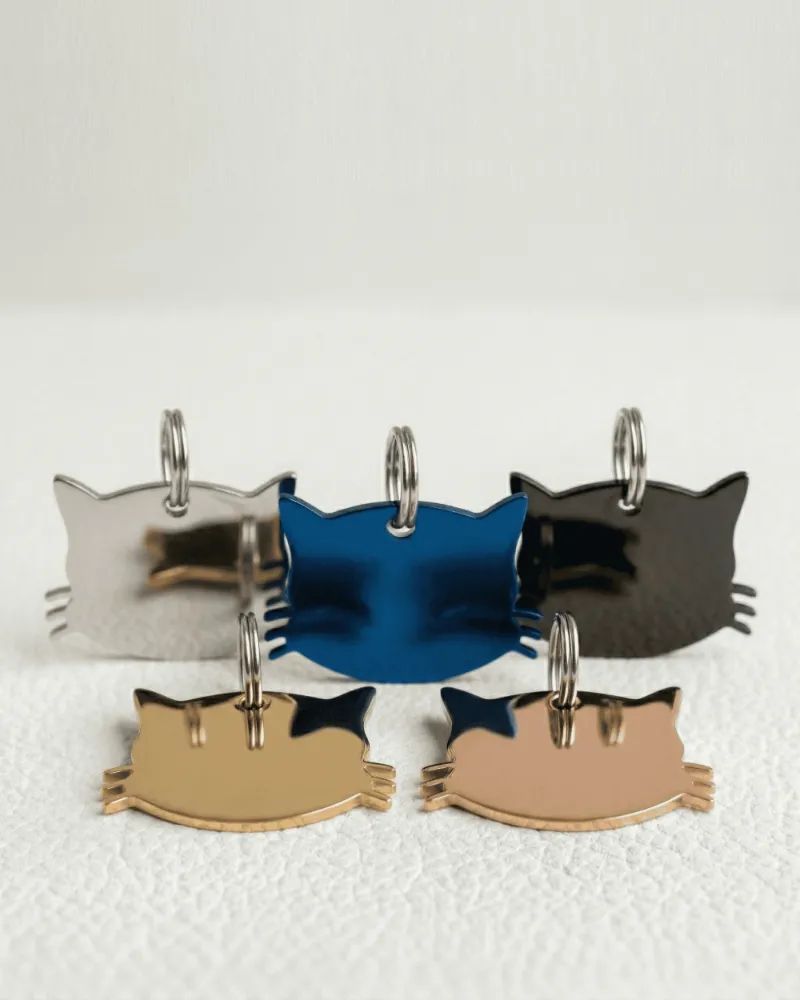
A good cat ID tag is light, carries your cat’s name and your phone number, and hangs from a breakaway collar. MoodTag is an Australian online store that makes premium, heavy-duty dog ID tags with the Never-Fall Ring, and we also engrave light cat ID tags in 2.0mm stainless steel, from 6 grams. This guide covers what to put on a cat tag, how heavy is too heavy, safe collars, the rules by state, kittens, and how to keep the collar on.
Engraving layout
What should you engrave on a cat tag?
Your cat’s name and one or two phone numbers. RSPCA Australia suggests exactly that, and says to update the tag if your details change. The phone number is the line that gets your cat home, so give it the most room.
On a MoodTag cat tag the layout is:
| Side | Line | Example |
|---|---|---|
| Front | Cat’s name | MILO |
| Front | Short line (optional) | Indoor Cat |
| Front | Custom text (optional) | I’m Microchipped |
| Back | Owner name (optional) | Sam |
| Back | Phone number | your mobile |
| Back | Microchip or council rego number (optional) | your number |
A few tips for cat name tags for collars:
- Keep the name short. About 12 characters reads cleanly on a small tag.
- "Indoor Cat" tells a neighbour your cat shouldn’t be outside, so they call you instead of assuming it lives nearby.
- Medical needs ("Needs meds") belong on the tag if your cat has them.
- Check the layout first in the Live Preview, then we engrave it.
Front and back
Front: name and a short line
Back: phone number
For more layout ideas, our guide to what to put on a dog tag works for cats too.
Weights
How heavy a tag can a cat wear?
As light as your details allow: our advice is about 6 to 9 grams for most cats. No Australian body sets a weight limit for cat tags, so the simple rule is the lightest shape that still fits your phone number clearly. Every MoodTag cat shape is 2.0mm stainless steel, sized for cat collar ID tags rather than dog tags:
| Shape | Size | Weight |
|---|---|---|
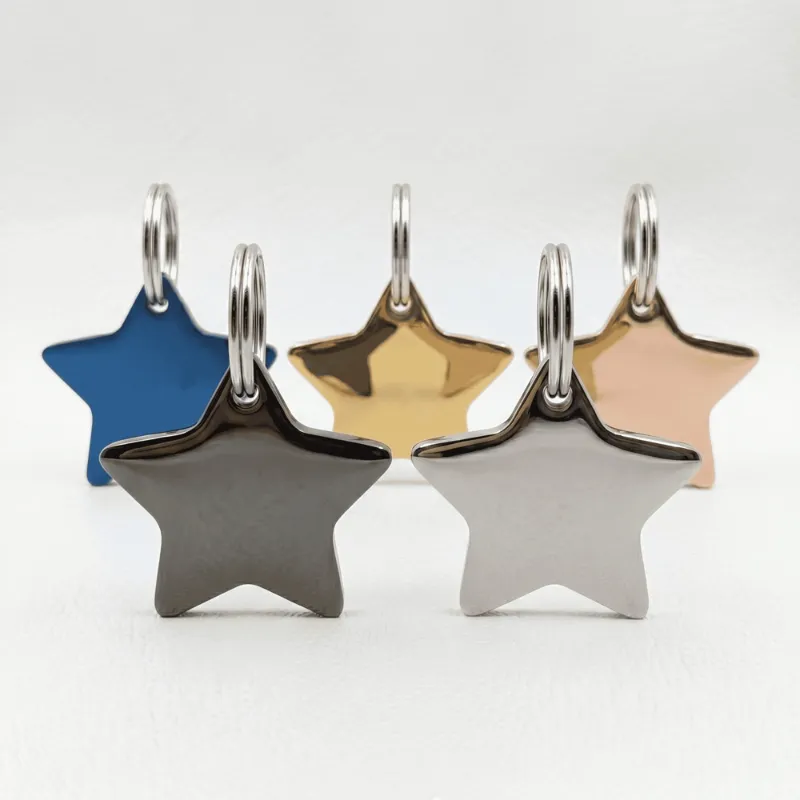
| Classic Star | 28 x 28mm | 6g |
| Signature Cat Silhouette, Small | 25 x 24mm | 6g |
| Classic Hexagon | 27 x 30mm | 8g |
| Luna Heart | 30 x 30mm | 8g |
| Classic Heart, Small | 33 x 26mm | 8g |
| Signature Whisker | 34 x 25mm | 8g |
| Classic Round, Small | 30 x 30mm | 9g |
| Signature Cat Silhouette, Large | 30 x 29mm | 9g |
| Classic Heart, Large | 35 x 33mm | 11g |
| Classic Round, Large | 35 x 35mm | 13g |
For kittens and small cats, start with the Classic Star or the Small Signature Cat Silhouette, both 6g. The Large sizes suit big adult cats or owners who want a bigger font.
Our large dog shapes, the Scout Military and the large Classic Bone, are too big for cats, so they aren’t in the cat range.
Breakaway collars
Does an ID tag work with a breakaway collar?
Yes, and a breakaway collar is the one to use. RSPCA Australia recommends a collar with a breakaway clip and ID tag, because the clip snaps open if the collar snags. It advises against fixed buckles and stretch collars that lose their elasticity with age.
The reason is real: RSPCA South Australia treated two cats with serious injuries from collars with no quick-release buckle, usually after a front leg went through the collar. A cat collar with a name tag works the same way: hang the tag from the collar’s ring as normal. The breakaway clip still opens; the tag simply goes with the collar.
That is also the catch. If the collar pops off, the tag goes too, which is why your cat needs a microchip as well.
State by state
Do cats have to wear a tag in Australia?
Only in WA and the ACT. Every state below requires cats to be microchipped, but a worn ID rule for cats applies only in those two:
| State | Cat microchip | Must the cat wear ID? |
|---|---|---|
| NSW | By 12 weeks or before sale | No (the collar and name tag rule is for dogs) |
| VIC | Before first council registration or sale; cats register from 3 months | No state rule |
| QLD | Before 12 weeks | No state rule |
| WA | By 6 months | Yes: a collar and council registration tag, $200 on-the-spot fine |
| SA | By 12 weeks, before sale, or within 28 days of taking ownership | No state rule |
| TAS | From 4 months | No state rule |
| NT | Check your council | Check your council |
| ACT | All cats; register from 8 weeks | Yes: identification, which can be a collar and tag with your contact number or address |
Councils can add their own rules, so check yours. In WA your MoodTag sits next to the council registration tag; it doesn’t replace it. Rules checked 2 November 2026.
Microchips
Does a microchipped cat still need a tag?
Yes, because only a vet, shelter or council can read a microchip. A tag can be read by the neighbour who finds your cat in their laundry, and they can call you straight away. RSPCA Australia puts it simply: a collar so your cat can be identified, and a microchip always. The chip is the permanent backup for the day the breakaway collar comes off.
Kittens
When can a kitten wear a tag?
There is no official minimum age; what matters is a kitten-sized breakaway collar, the lightest tag, and frequent fit checks. Kittens usually go to new homes from about eight weeks old, and microchip deadlines start at 12 weeks in NSW, QLD and SA.
Kittens grow fast, so RSPCA South Australia says to check collars often on young animals. Start with a 6g Classic Star or Small Cat Silhouette. When your kitten needs a bigger collar, keep the tag: open the 26mm attachment ring and move it across.
Keeping it on
How do you keep a cat’s collar on?
Fit it right, check it weekly, and keep putting it back on. In a study of 538 pet cats (Lord and others, JAVMA 2010), 73% wore their collar for the full six months, and the owners who expected it to work and refitted lost collars did best.
- Fit: you should fit one large or two small fingers between the collar and the fur. RSPCA links most collar injuries to collars that are too loose or too tight.
- Check weekly: RSPCA Australia says to check the condition and fit every week.
- Refit straight away when a breakaway collar comes off. Your MoodTag moves to the new collar on its 26mm attachment ring.
- Don’t panic about the collar itself. An Australian study found collar injuries are rare: vets reported about one collar injury every 2.3 years of practice (Calver and others, Animal Welfare 2013).
Noise
Is there a silent cat tag?
Not a hanging one: MoodTag cat tags hang from a split ring, so they can clink against a bell, a buckle or a second tag. If noise bothers your cat, use one engraved tag on its own, with nothing else metal on the collar for it to knock against.
Two other options:
- An embroidered collar with your number on it, which RSPCA Australia mentions as an alternative.
- Our Silent Slide-On sits flat with no jingling, but it is made for dog collars: it weighs 13g and the smallest size needs a 15mm wide strap. Check your cat’s collar width before choosing it.
One more thing to weigh up: for cats that go outside, RSPCA Australia suggests a bell or a bright collar cover to warn wildlife. It also recommends keeping cats at home.
Indoor cats
Does an indoor cat need a tag?
Ideally, yes. RSPCA Australia says cats kept at home should still wear a collar in case they escape. A tag that says "Indoor Cat" with your number tells whoever spots your cat that it shouldn’t be out, and lets them call you straight away.
Summary
Key takeaways
- Engrave the name on the front and one or two phone numbers on the back; update it when your number changes.
- Choose the lightest shape that fits: 6 to 9 grams for most cats, 6g for kittens.
- Use a breakaway collar, and keep the microchip details current.
- WA requires the council registration tag; the ACT requires ID; every state requires a microchip.
- Check the collar fit weekly and refit it if it comes off.
Common questions
Cat ID tag FAQs
What is the best ID tag for a cat?
A light, engraved metal tag on a breakaway collar, with your phone number clear on the back. Deep laser engraving is cut into the steel rather than printed on it, and MoodTag covers its readability for life.
Are stainless steel tags too heavy for cats?
No, a small stainless tag weighs 6 to 9 grams. Choose the lightest shape that still fits your number.
Should I put my address on my cat’s tag?
You don’t need to. RSPCA Australia suggests your cat’s name and one or two phone numbers, and a phone number gets the fastest call.
Can I put the microchip number on the tag?
Yes, if you want to. Every MoodTag cat tag has an optional back line for a microchip or council rego number, but your phone number matters more to a finder.
Do cat tags fall off breakaway collars?
The tag stays on the collar; the collar itself opens if it snags. That is why your cat should be microchipped too.
How do I put a tag on a cat collar?
Open the 26mm attachment ring with a thumbnail or the edge of a coin, slide it onto the collar’s ring, and turn it until it closes. MoodTag cat tags arrive with the split ring and attachment ring already on.
Made light for cats
Cat ID tags from 6 grams, engraved front and back
2.0mm stainless steel, deep laser engraved in Australia, ready to hang on your cat’s breakaway collar. $29.90 with free standard shipping Australia-wide and a 90-day money-back guarantee.