How to Choose a Personalised Dog ID Tag in Australia (5 Things That Matter)
If you’re buying a personalised dog ID tag in Australia, most tags look similar online—until you actually hold one, read it at arm’s length, and put it through real walks, rain, and daily wear.
Watch: A fast checklist to help you pick the right personalised dog ID tag in Australia—and avoid the common mistakes that lead to unreadable or short-life tags.
The 5-Point Checklist
1. Material: Stainless steel is the safe default
If your dog wears a tag every day, material matters more than most people think. Stainless steel is the safe choice because of its:
- Durability: Handles daily knocks, collar friction, and general wear better than softer metals.
- Finish retention: Holds its look longer with normal use.
- Practicality: Easy to wipe clean.
At MoodTag, our tags are designed to keep a premium jewellery-style look while still being “real-dog tough”.
What to avoid: Super thin, lightweight tags that feel like they’ll bend, or tags that look great on day one but lose clarity quickly with abrasion.
2. Engraving: Choose deep, readable engraving that stays clear
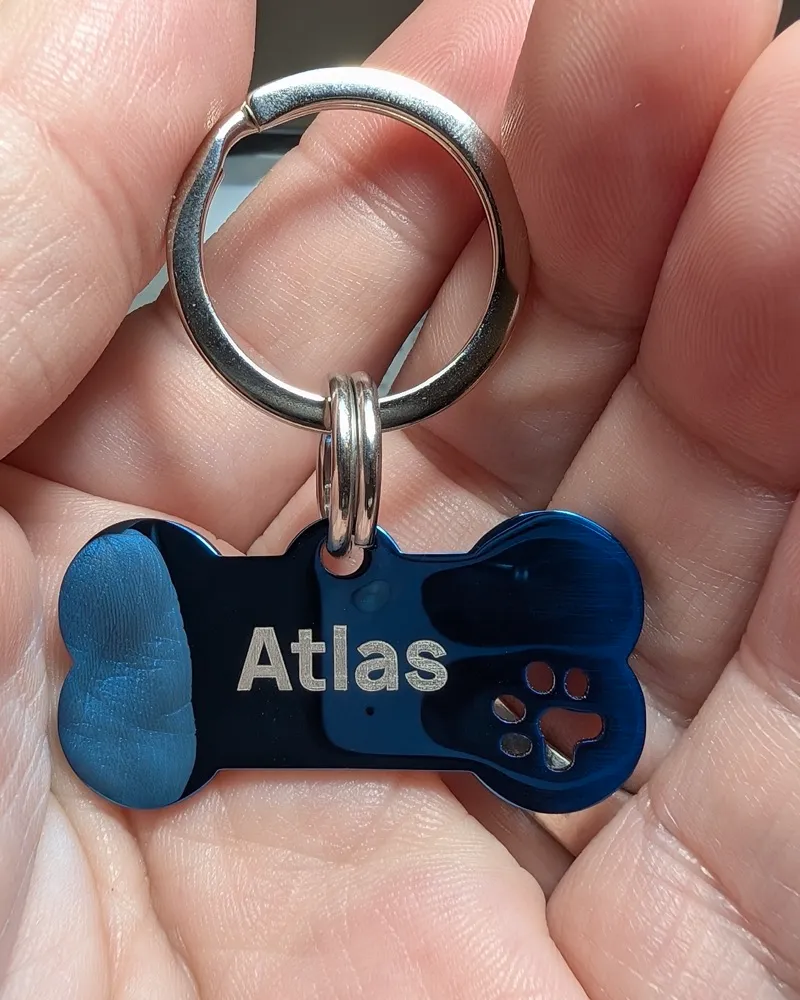
A tag is only useful if someone can read it quickly. Surface marking can look fine at first, but it’s closer to a “top layer” effect. Deep laser engraving creates a physical groove in the metal—so the text remains readable even as the tag gets normal wear. MoodTag focuses on this industrial method to keep contact details clear long-term.
What legible engraving looks like: Clear letter shapes (no “fuzzy” edges), enough contrast to read at a glance, and spacing that doesn’t cram everything together.
Real-world test: Hold the tag at arm’s length in normal indoor light. If you need to squint, it’s too small, too shallow, or too condensed.
3. Layout: Front for personality, back for safety
The biggest mistake people make is putting too much on one side. The ideal layout works because the front is what you see every day, and the back is what helps your dog get home fast if they wander.
- Front (Identity + Vibe): Dog name & Short personality line.
- Back (Recovery): Owner name & Phone number.
MoodTag is built around this exact idea: fun on the front, safety on the back. Engraving space is real physical space—shorter text = larger text = easier to read. (Stuck on what to write? Our AI Personaliser can generate the perfect short quote for you.)
4. Size: Make sure it’s readable at a glance
A tag can be beautifully engraved and still fail if it’s the wrong size for your dog. For small dogs, you want lightweight but still readable. For medium/large dogs, you can go larger for easier legibility.
Rule of thumb: If you can’t read the phone number quickly, the tag isn’t doing its job. This is why MoodTag’s product pages include a Live Preview Engine—you can see the line length, spacing, and layout before you buy.
5. Shipping: Look for tracked delivery in Australia
When people are buying a tag, it’s usually for a reason: moving house, a new puppy, an upcoming trip, or they’ve just had a scare. Tracked shipping matters because it removes uncertainty. MoodTag ships Australia-wide with tracking, so customers can follow delivery progress.
Common Mistakes to Avoid
❌ Mistake 1: Too much text
More text usually means smaller text. Smaller text means unreadable text.
❌ Mistake 2: Form over function
A tag is not jewellery only—it’s a safety item. Test readability at arm’s length.
❌ Mistake 3: Mixing details
A layout that mixes personality and contact details on one side is cluttered. Front/back separation is cleaner and faster for anyone who finds your dog.
❌ Mistake 4: Size based on looks
A slightly bigger tag that’s readable beats a tiny tag that isn’t.
Quick Answers (FAQ)
The Buyer Cheat Sheet
If you only remember one thing when buying, make sure you look for: Stainless steel • Deep engraving • Front for name/vibe • Back for owner/phone • Readable size • Tracked AU shipping.